
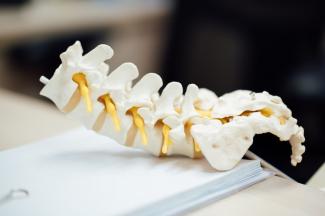
Our spine is made up of a series of intervertebral discs. These discs are spongy cushions that separate the bones of the spine. They help our body to absorb shock, helps us to be flexible by allowing movement and keeps the spine stable. Over time, these discs may become worn and damaged resulting in Degenerative Disc Disease (DDD). Degenerative Disc Disease is a condition in which a damaged disc causes pain. The severity of this pain can range from mild to severe and debilitating.
What Causes Degenerative Disc Disease?
There are several factors that can cause discs to degenerate. These include:
- Age
As you get older, your discs may show signs of wear and tear. They can get damaged, begin to break down and not function as intended, causing pain.
- Poor Blood Supply
Your blood carries the nutrients needed to keep the disc healthy. Any condition that reduces the blood supplied to the disc through the cartilage end plates will cause the disc to deteriorate as the nutrient requirements are not met. [1]
- Drying of the disc over time
The disc is comprised of approximately 80% water when we are born. As we age, the disc dries which limits its ability to absorb shocks well, which results in pain.
- Sports Activities
Participating in strenuous sports activities with specific postures and actions such as jumps, kicks and repetitive flexing and extension of the spine can cause DDD. These include athletes such as elite gymnasts, weightlifters, soccer players, and swimmers.
- Poor Nutrition
Not eating healthy will alter the body’s metabolism which will lead to poor delivery of nutrients to the disc space [1]. For instance, conditions like marasmus, cystic fibrosis, scurvy can lead to poor delivery of nutrients [1].
- Infectious Factors
In the presence of infection and an inflammatory response leads to rapidly accelerated degeneration [1]. It was observed that discitis precipitated an aggressive form of disc degeneration. This is due to pathogens and aggressive inflammatory response [1].
- Toxins
Toxins that affect blood supply will cause vascular factors of degeneration e.g nicotine [1,3].
Risk Factors
There are some individuals that are more prone to experiencing Degenerative Disc Disease because of certain risk factors. These risk factors include:
- Aging
- Poor nutritional status
- Cigarette smoking
- Obesity
- Infections
- Genetic predisposition
- Road traffic accident
- Sports e.g weightlifting
- Diabetes Mellitus
- Autoimmune disease e.g Rheumatoid arthritis, reactive arthritis
Symptoms/Signs
Common symptoms of Degenerative Disc Disease are:
- Pain in your lower back, buttucks, neck or upper thighs.
- Pain that is worse when sitting, bending, lifting or twisting.
- Numbness and tingling in the extremities.
- Pain that gets better when you walk, lie down or change positions.
- Periods of severe pain that come and go.
Treatment
In the case of failed conservative treatment of degenerative disc disease, the option of surgery is available if symptoms persist.
- Lumbar Surgery
You are eligible for surgery if you have severe spinal stenosis, uncontrolled pain, 6 to 12 months of nonsurgical treatment failure, and changes on MRI imaging [4,9].
There are two categories of Lumbar surgery:- Decompression procedures
This involves the removal of a bone or disc material to relieve your nerves that are pinched or compressed [4]. Surgical procedures considered in this category are: laminotomy, laminectomy and lumbar discectomy [4,5]. - Spinal Fusion Procedures
This procedure uses bone tissue to connect two or more vertebrae at the affected disc to decrease the pain by preventing motion [4,9]. Surgical procedures considered in this category include: posterior lumbar interbody fusion, transforaminal lumbar interbody fusion, anterior lumbar interbody fusion, oblique lumbar interbody fusion and posterior lateral interbody fusion [4,9].
- Decompression procedures
- Cervical Surgery
You are eligible for cervical surgery if you have severe spinal stenosis, persistent pain, decreased muscle and sensory function that are worsening, and persistent symptoms experienced in a reasonable period of nonsurgical therapy [4]. The aim is to relieve pressure of the nerve roots in cervical radiculopathy as well as to relieve pressure of the spinal cord in myelopathy [4].
Benefits of Surgery
Spinal surgery has shown to offer significant improvement to persons who suffer from Degenerative Disc Disease. If all forms of nonsurgical treatment have failed, ask your medical practitioner about the best possible surgical options for you. There have been positive results such as:
- Improvement of neurological outcomes and ability to do daily activities was as high as 90% [5].
- Improved movement after cervical surgery was seen after follow up in up to 78% of the patients [5].
- Improved functioning after lumbar surgery [5,6]
- Reduced disability, leg pain, and back pain after lumbar surgery. [5,6]
However, you should consult with your Surgeon about realistic expectations and the possibility of any residual symptoms [6].
Recovery
After approximately 1 to 7 days patients can be discharged from the hospital [4]. Lower back exercises are encouraged, and light activities started after 2 to 6 weeks [4]. Heavy activities are started after 12 to 16 weeks. Physiotherapy is included in the recovery phase and review dates are set at intervals of 2 to 6 weeks [4]. Braces may be recommended after certain lumbar surgeries.
Schedule a consultation today to determine if your pain is caused by Degenerative Disc Disease and if surgery is the right option for you.
References
- Boah, O., A., Abu-Bonsrah, N., Goodwin, R., C., Sciubba, M., D. (2017). Intervertebral Disc Degeneration. 1ST Edition. Nova Science Publishers. New York. Pp 1 -15. [Accessed on 11/06/22]. Available from https://www.libribook.com
- Choi, Y. (2009). Pathophysiology of Degenerative Disc Diease. Asian Spine Journal. 3. Pp 39- 44.
- Hadjipavlou, A., G., Tzermiadianos, M., N., Bogduk, N, Zindrick, R., M. (2008). The Pathophysiology of Disc Degeneration. The Journal of Bone and Joint Surgery(Br). 90-B. pp 1261-1270. [Accessed on 11/06/22]. Available from https:// doi:10.1302/0301-620X.90B10.
- Kishner, S. (2021). Degenerative Disc Disease. [Accessed 11/06/2022]. Available from the Medscape App
- Kosztowski, T., Oyelese, A., Gokasla, Z. (2017). Intervertebral Disc Degeneration. Nova Science Publishers. 1st edition. New York. Pp 63 -86. [Accessed on 11/06/22]. Available from https://www.libribook.com
- North American Spine Society. (2011). Diagnosis and Treatment of Degenerative Lumbar Spinal Stenosis. Evidence-Based Clinical Guidelines for Multidisciplinary Spine Care. [Accessed on 12/06/22]. Available from https://www.spine.org/Portals/0/assets/downloads/ResearchClinicalCare/Guidelines/LumbarStenosis.pdf
- Pan, J., Pendharkar, V., A., Park, J. (2017). Intervertebral Disc Degeneration. Nova Science Publishers. New York. Pp 37 -62. [Accessed on 11/06/22]. Available from https://www.libribook.com
- Shepherd, D., Kerezoudis, P., Clarke, J., M., Bydon, M. (2017). Intervertebral Disc Degeneration. 1ST Edition. Nova Science Publishers. New York. Pp 127 -155. [Accessed on 11/06/22]. Available from https://www.libribook.com
- Schizas, C., Kulik, G., Kosmopoulos, V. (2010). Disc Degeneration: Current Surgical Options. European Cells and Materials. 20. Pp 306 – 315. [Accessed on 10/06/2022]. Available from https:// DOI: 10.22203/eCM.v020a25